
All I’ve got is a photograph, but it’s not enough.
Time Lapse presents a thrilling and personal take on the time travel genre, without any actual time traveling occurring. Instead, it walks three characters through the trauma and paranoia involved with knowing what’s coming and being incapable (or unwilling) of changing their future.
First Impressions
While checking in on a neighbor at their apartment complex, three people find a giant camera that can take pictures of the future. Amazing! So what do you use it for? Betting on horse races, of course. But when the bookie becomes curious and tries to muscle his way into the winnings, things get dangerous quickly. How far will they go with their Time Lapse?
Presented below is the trailer for the film.


Time Lapse title card.
The Fiction of The Film
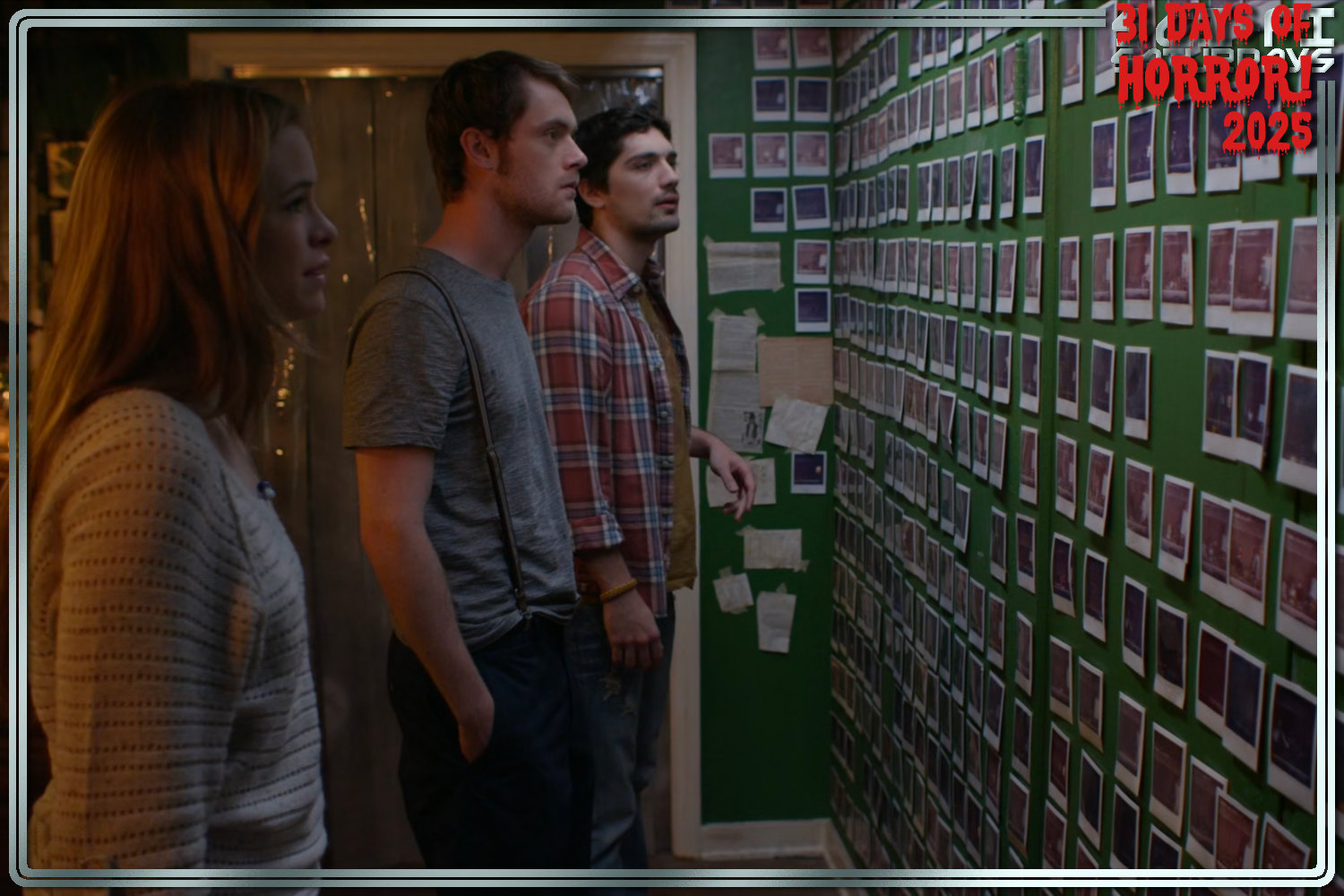
Finn (Matt O’Leary), a painter with a creative block who is also the superintendent of the apartment complex, lives with his girlfriend Callie (Danielle Panabaker), who has been feeling distant from Finn lately, and their friend Jasper (George Finn) in a ground-floor apartment in Denver. When the landlord calls, indicating that Mr. Bezzerides (John Rhys-Davies, who appears in photos only) is late with the rent, Callie checks on his apartment to find him missing. Later, Finn and Jasper join her to discover hundreds of Polaroid photos showing their apartment window and a giant machine bolted to the floor, which spits out a new photo at 8 pm. The photos on the wall depict all sorts of scenes with the characters, and are seemingly voyeuristic, until they look at the new photo, which depicts something that hasn’t happened yet.
Checking out Mr. B’s storage locker, the trio finds the dead and mummified-looking body of the scientist. They realize he’s been dead just over a week. Realizing the machine takes photos 24 hours into the future, they decide to keep his death a secret by paying his bills and watering his plants, telling security guard Big Joe (Amin Joseph) that he’s in the hospital. Jasper wants to profit from the machine by betting on races with his bookie. During an engagement party for a friend that night, Finn takes a photo on his phone at 8 pm, which matches the photo they received the night before. A perfect match. The newest future photo shows race results in the window, but more importantly, a finished painting on Finn’s easel. They believe that Mr B. failed to follow what he saw in the future and was killed by time itself.
Things go fine, with Jasper winning money on races, until a photo shows Finn painting while Callie and Jasper kiss behind him, creating tension amongst the three roommates. Attempting to recreate this event (or face unknown consequences) causes Callie and Jasper to kiss too long, further raising Finn’s jealousy. The next future photo shows Ivan (Jason Spisak), Jasper’s bookie, in the room the following night. Jasper calls the next morning, telling Ivan he doesn’t want to place a bet, which raises the criminal’s curiosity, making him show up that night. He muscles his way into the enterprise, leaving 5% of any winnings to Jasper, and withholding the photos from the group, upsetting Finn, who can no longer see the images he paints in advance.

Jasper, Finn, and Callie go about their day not realizing that they have become the subjects of a dangerous experiment.
One night, Jasper sneaks a snapshot of the future Polaroid image before Ivan’s enforcer, Marcus (David Figlioli), can snatch the photo. Finn’s painting is back, but this time it’s a rudimentary skull and crossbones, which Jasper takes as a warning that Ivan is gunning for them. Marcus sees Finn talking with Big Joe, who stops by to drop off his security keys, saying he’s just gotten a job as a police officer. This instigates Ivan to stop by, threatening Callie specifically if the others don’t tell the truth. An increasingly paranoid Jasper kills Marcus and then Ivan. They add the bodies to the storage room with Mr. B‘s body. Callie, who has been finding Finn’s recent attention exhilarating, becomes upset at him for failing to protect her. That night, Dr. Heidecker (Sharon Maughan), Mr B’s colleague, shows up looking for him.
They show her what happened to the scientist, but she scoffs at their assertion that he was killed by time. She points to a canister on the floor and says it’s more likely the thorium gas that killed him. The photo he sent her is from tomorrow, showing an image of blood on the roommate’s window and Mr. B’s hat, but it was taken at least two weeks ago. Jasper shoots Heidecker, fearing that she might also want a cut of the machine, much to Finn’s shock. The next future photo instead shows Callie and Jasper having sex with an unconscious Finn on the couch. Finn wistfully tells Jasper he should have asked Callie to marry him a year ago, as he planned, just before Jasper knocks him out and locks him in the storage room.
Finn escapes and threatens to destroy the machine if he and Callie aren’t allowed to leave. Jasper gets the upper hand and almost kills Finn, but Callie appears and smashes Jasper’s head with a crystal ball, killing him. She shows Finn the future photo, which has now changed to no longer show sexy time, but police tape across the window. Except Finn sees the painting in the photo is one he hasn’t painted, and it is still the same, proving they haven’t changed anything. Callie confesses to hiding the fact that the machine also spits out an 8 am photo, which she has been using to send messages to herself to hide an affair with Jasper, and make Finn fall deeper in love with her. She shoots Finn, which splatters blood on the window. She then places a note in the window for her past self to change these events. Unfortunately, Big Joe shows up, spurred by a call from Finn, and sees the murder scene. He arrests Callie and carries her away. The note falls from the window, creating the photo Mr B took weeks ago. The camera takes a final, unseen photo.
“We obviously have no control over what’s happening.” – Finn

Life seems to be going great as the trio picks up the newest future image.
History in the Making
Welcome to the beginning of another month of 31 Days of Horror, as Sci-Fi Saturdays looks at four films that skew further towards horror and terror than usual. First up is Time Lapse, a thriller that is an intimate, independent-style film about the dangers associated with thinking you know your future. It was written and directed by Bradley King and is his only feature film to date. It’s a small but engrossing film that makes excellent use of a small cast and one major location. And while the film doesn’t deal with horror in an overt way (no zombies, mass murderers, or supernatural events), it delves into the existential horror of knowing what’s coming in the future but not the context surrounding it. Told through the eyes of Finn, an artist, the premise takes on a hopeful narrative, as he uses the premonitions of the future to help solve his creative block. Knowing that in 24 hours he will have produced a painting (and even knowing what it looks like) provides some comfort to a character who has difficulty digging deep into his talent to devise a new work. On the other side of the coin, Jasper sees the photos of tomorrow as another addiction to chase. Already dealing with a gambling problem, which has pushed him deep into debt, the promise of a sure thing is too much for him to pass up as he bullies the others into following his lead.
The characters end up becoming slaves to the photos, living each day toward the events depicted in the image. This includes Finn painting the picture, Jasper gathering the race results to post, and Callie filling in whichever role is called for her that evening. When the characters are not in the frame, they speculate that they may be just off-screen. On a night when only Jasper and his bookie appear, Finn goes to sit in the car. As Callie follows, she asks where he’s going, to which he answers, “Nowhere.” Without the photo to help justify their actions, the characters are aimless and uncertain. They dread altering the scenes depicted in the photos for fear of being erased or somehow being “eaten by time.” Based on a limited quote from Mr B’s journal, the group mistakenly believes that the cardinal rule of time and causality is not to change the future. He’s the scientist, so they assume that he must know what’s going on. But they later realize that this is not the case. Dr. Heidecker scoffs at them for believing that somehow time punished the Doctor for some transgression. When they ask what else it could have been, she provides a much more rational answer. Yet somehow that statement is not as reassuring as it should be, since the remainder of the film still continues to play out as prophesied by the photo sent to Dr. Heidecker weeks before it occurred.

Ivan, Jasper’s bookie, and his enforcer Marcus attempt to understand just what is going on here.
Genre-fication
Time Lapse shares much in common with a 1960 episode from Season Two of The Twilight Zone entitled “A Most Unusual Camera.” In that story, three characters, two men and a woman, steal a magical camera from a pawn shop, which they soon realize can take pictures of the future. They get the idea to photograph the blank scoreboard at the local horse track prior to the race and then bet on the winners. A fourth character, a waiter, translates the foreign language on the camera, indicating that there are only 10 photos allowed per person. As they come close to the tenth, the two men, who are brothers, fight and fall out of the window. The woman, surprised when the waiter comes back to rob them, falls out the window as well. The waiter looks at the final photo she took and sees four bodies on the ground outside. He’s so startled that he too falls out the window and dies. The poetic justice of everyone coming into contact with this damned object is a very strong narrative device. In both cases, learning the future creates a curse that ends when you die, and much sooner than would be expected.
The film also shares elements with more recent science-fiction films, both within the time travel genre, such as Primer and Paycheck. Primer is a small, independent film about time travel that also has a small cast. It deals with the paranoia that comes from time travel and ensuring that all the necessary steps are followed to engineer perfect days (in that way, much like Edge of Tomorrow as well). On the other hand, Paycheck only deals with the ability to see into the future; no time travel is necessary. In that film, Ben Affleck’s character looks forward and sees what objects he may need in his immediate future in order to survive being killed by the tech company that has hired him. Unlike any of these other films, the ability to see the future becomes a useful tool for the protagonist, allowing him to survive and stop the bad guys. What most of these films show is that time is extraordinarily difficult to change, if not impossible. In Time Lapse, it’s absolutely fated to occur regardless of anyone’s actions.

With bookie taking 95% of their winnings, things turn from bad to worse.
Societal Commentary
Fate, and its counterpoint, free will, is a common theme in time travel fiction. Most stories pick one of these two elements to focus on. The upbeat films utilize free will, as it reveals that each person has a choice in how they go about their lives, while darker stories often use the premise of fate. Most time travel films that end with a death were always fated to do so. Time Lapse is most certainly the latter type of film. Information on the photographs is presented to the audience and the characters ahead of time. When that moment finally occurs, regardless of the events in between, it happens just as the photo predicted 24 hours earlier. When the three enter Mr. B’s apartment, one wall is covered in photographs showing them in their living room. Some photos are missing, but what they do see all appears to them as events that have occurred over the previous weeks. From their vantage point, at that time, these are all events in the past, no question. But when the machine spits out a photo from tomorrow night, they disbelieve what they’re seeing initially because the event has not happened yet. Society has become so accustomed to photographs, especially Polaroids, being a document of what happened in a precise moment in time rather than a prediction of a future moment. In this case, that is still true. Just because the image arrives 24 hours early (or earlier) doesn’t mean that it’s also not an accurate portrayal of the same events.
Throughout the film, the characters often claim the inability to change what they’ve seen of the future. Finn, for one, doesn’t want to change the events because, for once, he’s able to nurture his art by getting glimpses of it from the future. He threatens to stop, or not do something (or, gasp, destroy the machine), but he always backs down. Jasper uses it as an excuse. “I’d change things, but…” is his thinking. For him, things are going so well. He’s winning at life (and dog races), and he just has to make sure that Callie and Finn fall in line, because if they don’t do the things the photos show, it could affect him as well. He claims a lack of control in the events because he’s just “doing what the photos tell him to do.” Yet, he never seemed concerned about control in his life before he knew of the future. The only difference now is that his life is trending upwards (apparently) rather than spiralling downward. But all that pressure of worrying about keeping others in line, and his constant anxiety-driven drug use, raises the level of paranoia in his life. Seeing a single moment in the future, out of context, sends his mind spinning with all the possibilities of what may have happened to get them there. It’s enough to drive anyone mad. And then there’s Callie, who’s been using the system longer than anyone else. She has kept the 8 am photos a secret from the boys and uses those to attempt to tell her future self about the best way forward. But even with her, it’s always a game of catch-up. The picture seen is from tomorrow, looking back with the hindsight of a day lived. If you received a limited message from tomorrow saying not to visit the market, what does it really mean? Trying to move forward to a fixed point (or avoid the same point) can make it so that other, more important things might be missed. She also believes that somehow she can change the past by putting up a new message for the machine to take a photo of. But as the conclusion shows, this is literally tempting fate. The message will fall down, or some other act of God will occur to make it so that it can’t happen. Why? Because it hadn’t happened when you got the picture the night before, so it can’t change now.

The future holds nothing but pain and misery for Finn when he sees no painting and his girlfriend screwing his roommate.
The Science in The Fiction
I’d love to be able to explain any of the science behind the camera, but I can’t do that, since the picture I got of this article (sent to me last night) failed to have any of the details in it. All the audience can know is that the machine probably works with thorium gas in some way, since that was what killed Mr B. in his storage room. No real evidence presents itself as to how thorium might work in a case like this. It may have been chosen by the filmmakers due to it being an element that the general public is not intimately aware of. But this is for the best. Knowing how the device works would detract from the larger story, since that camera is not the important part. It provides the information that the characters decide what to do with. It’s the deus ex machina that drives the story like so many other narrative devices. If you do want to get an idea of how a machine like this might be able to take a picture into the future, check out the Sci-Fi Saturdays article on Paycheck for how one film did it.

Jasper threatens Callie’s life if Finn doesn’t comply.
The Final Frontier
Time Lapse is an intricate little film that is full of self-consistency and self-fulfilling prophecies. All the moments teased in the future pay off in one form or another. The photo that Mr. Bezzerides falsely believes signals his death (due to his hat being in Finn’s apartment) turns out to be a misinterpretation of the future. His hat was there because when he died weeks before this event, Jasper picked it up and brought it home with him. This illustrates the problem with attempting to understand the future based on a single image. A bunch of photos are missing from the wall in Mr. B’s apartment. This isn’t questioned at the start, but is later revealed to have been removed by Callie because they showed her and Jasper in some kind of dalliance. Everything that was on the wall is true of reality, and all the new future images eventually turn out just as the machine predicted they would.
Perhaps the setting of the film has something to do with the horrific aspects of the story and the ill-fated ends met by everyone who came in contact with the machine. Based on the license plates on the cars and the return Zip Code on the letter Callie mails, the film takes place in Colorado, possibly outside Denver. What other famous horror film takes place in Colorado, but The Shining, a film about a man fated to insanity, filmed in a single location. This may be a bit of a reach, but crazier ideas have been made on the internet. As with other mystery-type films, Time Lapse has much to see on subsequent future watches. And unsurprisingly, the outcome of the film never changes. Each element is foreshadowed in a way that is not necessarily evident on first viewing. Take the example of Jasper picking up a glass orb and using it as a crystal ball to pretend to see into the future. That object becomes his undoing as Callie bashes his head in with the same glass ball. Bet he didn’t see that one coming.
Coming Next


Having grown up on comics, television and film, “Jovial” Jay feels destined to host podcasts and write blogs related to the union of these nerdy pursuits. Among his other pursuits he administrates and edits stories at the two largest Star Wars fan sites on the ‘net (Rebelscum.com, TheForce.net), and co-hosts the Jedi Journals podcast over at the ForceCast network.