
Please remain seated with your seat belt fastened and keep the aisle clear until we are parked at the gate.
Arrival presents a unique and hopeful account of first contact with an alien species. But it also shows the difficulties inherent in communication with others, let alone extraterrestrials. Remember, in the world of language, there are no winners and losers, only shades of misinterpretation.
First Impressions
This trailer provides imagery of UFOs appearing around the globe as seen through one scientist’s eyes. She and her team are attempting to make first contact inside the alien ship. Of course, the military gets involved, and tensions are running high. She removes her protective suit and puts her hand on a glass partition. An alien “hand” touches the other side of the glass. What is the meaning of their Arrival?
Presented below is the trailer for the film.


Arrival title card.
The Fiction of The Film
Louise Banks (Amy Adams) recalls memories of her daughter, Hannah (Abigail Pniowsky, Julia Scarlett Dan), as a baby, a young girl, and a tween. Hannah becomes sick and dies at age 12 from cancer. Louise, a linguistics professor at a college, has her class interrupted by a news report that twelve alien ships have landed around the world, including one in Montana. She seems depressed by the events as the news reports disturbing stories from around the globe. Colonel Weber (Forest Whitaker) visits Louise at her office the next day, having worked with her translation services before. He offers her tape-recorded sounds of the aliens, but she is unable and unwilling to work this way. The Colonel leaves, but after checking with another colleague, he returns the next morning to take her to the site in Montana.
The alien craft levitates several feet off the ground, opening a portal every 18 hours. Louise is immediately suited up, along with theoretical physicist Ian Donnelly (Jeremy Renner), and they are taken to the craft. A scissor lift elevates them so they can enter the opening vertically above them. Colonel Weber shows them how gravity changes in the hallway from a vertical orientation to horizontal. Along with three other military technicians, the six humans step into an anteroom separated from two seven-armed aliens (heptapods) by a clear barrier. The creatures exude basso and vibrational sounds, not unlike whales. The humans are only allowed to stay for a bit over 112 minutes before being “escorted” out of the ship by a gravity change.
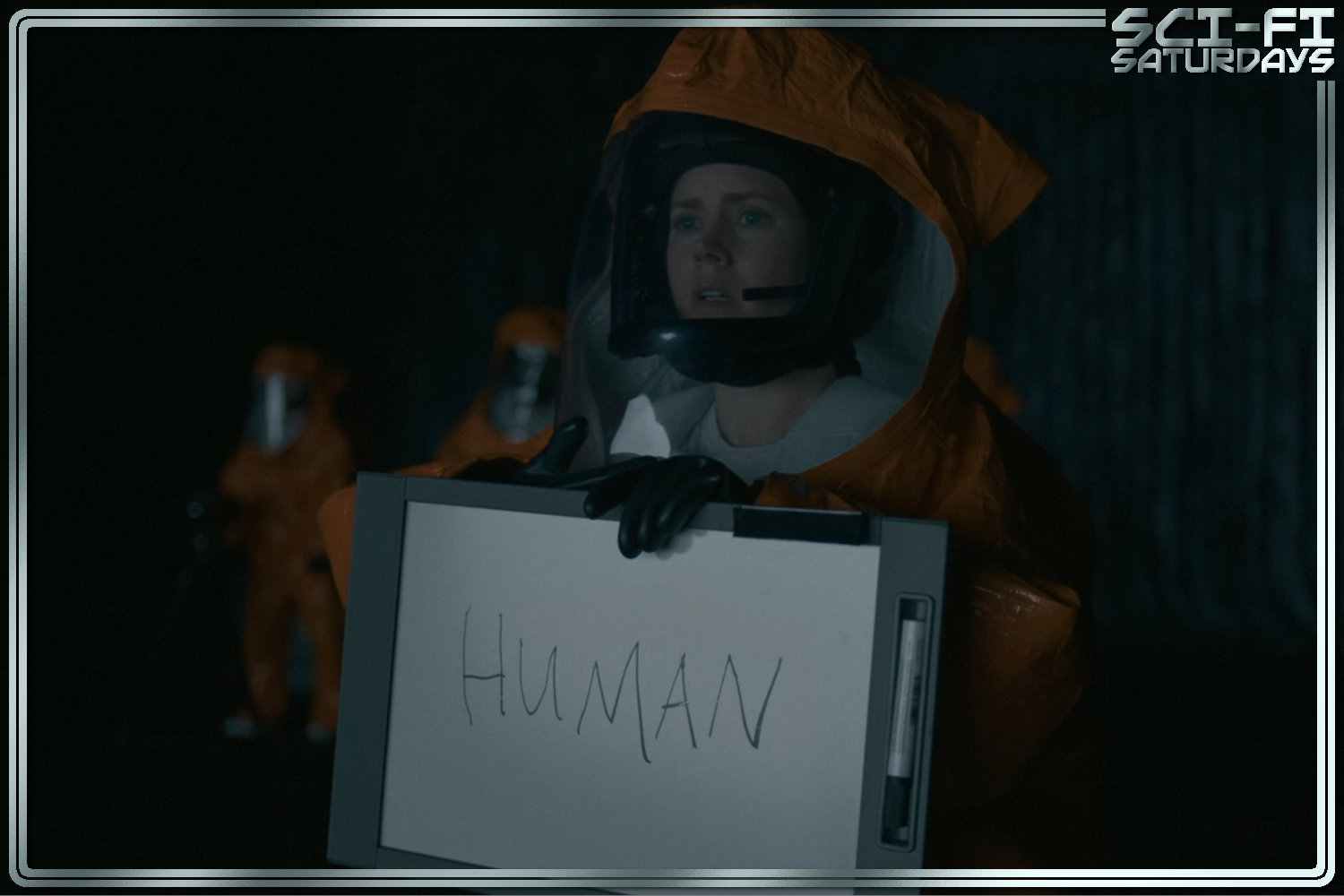
Louise is frustrated, but returns again with a whiteboard as she attempts to communicate with writing. The group continues to follow protocol and dress in bulky hazmat suits, carrying a small bird in a cage to detect atmospheric changes, even though their devices say the air is breathable and no radiation exists. One of the heptapods blasts an inky circle onto the glass divider, but it’s unlike anything Louise has ever seen. The Colonel wants things sped up for his bosses, but Louise knows that mistakes or assumptions can lead to confusion and worse as she shares a story about the origins of the word ‘kangaroo’ with Aboriginal Australians. Louise explains why she needs to start with “grade-school words,” helping her understand their language.

A strange alien ship arrives in Montana.
On the next visit, Louise strips out of her hazmat suit, to the shock of everyone else, because she needs the aliens to “see” her. She places her hand on the divider and is met by a reciprocal event from the alien creature. Louise has further flashbacks to her daughter playing while she works on decrypting the alien logograms. She and Ian take a few moments together, away from the chaos, to talk about their lives. A right-wing news host on television suggests a “shot across the bow” to show the aliens who is in charge. Progress is slow, but the group translating the heptapod symbols manages to start unraveling them. Ian and Louise discuss the way that immersion in a language can actually require the brain. The Colonel provides word that the Chinese General, Shang (Tzi Ma), is planning something and that other nations will follow him.
Weber tells Louise she must get to the “big question” of why the aliens are here, even if she’s not ready. The answer from the heptapods, “offer weapon,” makes the military bristle, and fires up CIA agent Halpern (Michael Stuhlbarg). A group of four rogue soldiers decides to place a bomb in the chamber, not knowing that Louise and Ian are headed back inside for a clarification of the alien’s message. The heptapods warn the pair of the imminent explosion by writing tons of smaller messages on the glass before expelling them. After the explosion, all the ships move away from their lower position, so that no further damage can be done. Louise counsels staying to continue the work, but with China declaring war on the aliens, the US military needs to prepare.
Louise has a feeling and walks toward the craft, where an alien shuttle picks her up. She learns that one of the aliens is dying from the explosion. The alien explains that “Louise has weapon,” and that in 3,000 years the aliens will need the help of humans to survive. The heptapod language is non-linear and has rewired Louise’s brain to perceive events free of time, including her daughter–which is not a flashback, but a flashforward. In 18 months, Louise meets General Shang, who thanks her for helping avert a war. He provides his private phone number and the message she shared with him. Now, at the army base, Louise makes a call to the General and shares the information she has learned in the future, preventing a war. The aliens leave, and Louise knows that she and Ian will soon become lovers and have a daughter. Even knowing the end of Hannah’s story, Louise embraces her future.
“Despite knowing the journey and where it leads, I embrace it, and I welcome every moment of it.” – Louise Banks

Linguist Louise Banks makes first contact with a new species of heptapods.
History in the Making
When is a time travel film not a time travel film? When it’s Arrival, the first sci-fi film by Denis Villeneuve. The director, known at the time for gritty dramas such as Prisoners and Sicario, had been looking for a genre project for some time when this script was brought to his attention. The screenplay, by Eric Heisserer, is based on the Ted Chiang novella “Story of Your Life.” Both stories are similar, though this film version expands on various elements, making parts of the story more cinematic. Villeneuve makes the film his own by creating a wonderfully moody piece that contains subtlety and misdirection as it explains the infinite variations of language itself. He would follow this up with more sci-fi goodness, including the much-awaited sequel, Blade Runner 2049, along with Dune and Dune: Part Two.
The atmosphere of the film belies the emotionally complex package inside. Many first contact stories exude fantastical and technologically advanced imagery. Arrival chooses to look more like a dystopian film with a gray, misty, and dreamlike atmosphere. The film is about dealing with loss and the acceptance of the inevitable, but also comes off as a Cold War thriller about overly suspicious governments not trusting the arrival of aliens. The moody nature of the film leads audiences toward the somber, melancholy that Louise experiences throughout the film, as they erroneously believe she is recalling the death of her daughter before the events of the film.

Colonel Weber, CIA Agent Halpern, and other military staff watch the scientific team work on monitors.
Genre-fication
Arrival takes the best elements of many alien first contact stories and plays with them in a new and interesting way. It often focuses on the linguistics of the alien language, which is shown to allow fluent users the ability to experience time in a non-linear fashion. To most sci-fi films, alien arrivals and time travel stories are two different subgenres. Yet, Arrival puts them together with a tense political element to make something greater than the sum of its parts.
One of the most cherished and well-liked films about the first contact between humans and aliens is Close Encounters of the Third Kind. It follows one character as he is compelled to get to a location where the aliens will eventually land. It has many of the hallmarks that inform the genre. It’s told from an individual’s perspective. In this case, a civilian rather than anyone associated with the sciences or government. It features communication with the aliens in the form of musical notes. And it reveals a very positive emotional tone in regard to the arrival of aliens, which the film believes to be one of the greatest things to happen to the human race. Contact is another film that follows more closely in tone to Arrival. A female scientist is the main protagonist. She has complex emotional reasons for wanting to become the first to make contact with aliens, all while a bureaucratic team decides what is really best for everyone. Like Lousie, Ellie experiences things that she is unable to properly express to the others during her close encounter. As with CE3K, Contact is an emotionally hopeful film when it comes to the lessons that can be learned from contact with another species. Arrival continues that tradition by creating a film that surprises audiences with the last-minute twist, turning a film that appears to be about grief and coping with loss into a look at emotional maturity and living for experiences rather than outcomes.
But is Arrival a film about time travel? It is, yes, but not in the traditional sense. The film opens with footage of Louise experiencing moments with her child, Hannah. Hannah would eventually get ill and pass away at a young age. This is followed by what appears to be a melancholy Louise adjusting to the arrival of alien ships. She is neither happy nor shocked. At key moments throughout the film, flashbacks occur as Louise remembers a moment with Hannah, which somehow informs the present-day moment. The most telling one is Hannah asking about a word for when people work together, and they both receive benefits. Louise is shown “in the past” coming up with the term zero-sum game, which informs her present self as she finally understands the heptapods. Except that none of these moments are flashbacks. They appear to be, because that is the way that audiences understand the filmic language. Events happen in order, and when a previous event is shown again later in the film, it’s understood to be a return to that event–a flashback. But in Arrival, these are flashforwards, something that Lost was known for doing during its fourth season in 2008. That show had accustomed audiences to an understanding of flashbacks being footage that occurred off-island, but changed the format, thereby playing with the visual language. There is no actual time travel in Arrival, just as there is no actual time travel in Kurt Vonnegut’s Slaughterhouse Five. Instead, it’s the way that the protagonist experiences time, where she remembers the future as easily as she remembers the past.

The hepatapods communicate by spewing an inky black substance on the clear divider within their ship.
Societal Commentary
Surely audiences who went to see Arrival never bargained for learning more about linguistics than any other film they’d ever seen. Surprisingly, more films about first contact don’t cover the pitfalls of communication with alien species. In reality, humanity obviously has enough difficulties communicating with those that speak their own language, let alone individuals that speak different ones, extraterrestrial or not. While language is about using spoken tones or written ideograms, it is not a one-way street. The speaker and the listener must both interact with one another in the exchange of ideas. Listening and reading are not passive activities, but require focus and engagement to be understood. So much of the film is about the unspoken assumptions that humans make. Colonel Weber’s role is clearly one incited by fear. Fear of the unknown, tasked by his commanders to determine any hostile intent from the heptapods. People who need to know, “How can this be used against us?” Louise is there to ensure that the intentions of the aliens are correctly interpreted. She also acts as a de-escalation point. The military, specifically CIA agent Halpern, is so focused on the evil intent of the creatures that they miss the greater message. Louise attempts to explain these types of misunderstandings based on an apocryphal story about the naming of the kangaroo.
Louise mentions that the original colonizers to Australia asked the aboriginals what the name of the animal with the baby in its pouch that hopped around was called. The Aborigines said, “Kanguru”. Except, “kanguru,” she explains, means “I don’t understand.” She attempts to prove her point to a Colonel who sees the aliens as the colonizers and humanity as the aboriginals. He points out what happened to the Aborigines in that case. The filmmakers use another example of a poor assumption, or perhaps a lack of imagination, by the Chinese research team. Their team was using examples of the game Mah Jong to interact with the aliens, having logograms that they could use to communicate. Louise is strongly concerned that they have given the heptapods the wrong intention. She explains the issue using chess as an example. First, it’s a game, which language is not. Games require winners and losers, opposition and defeat. Language is an exchange of ideas used to promote understanding between individuals. This escalation between the Chinese and the aliens changes the timeline, introducing a ticking clock for Louise and Ian to complete their work.
The heptapods communicate in a language that seems extremely, well, alien to audiences. Their audible communication is whale-like in its resonance and tone, but their written words/phrases are inky circles. These logograms look sloppy and random to begin with. To the untrained eye, they are all exactly the same. But as Louise and her team discover, they are full of nuance and variation, providing a complete idea (a sentence) in one shot. As audiences learn, the heptapods and their language (or as a result of their language) are able to perceive time differently than humans. Louise explains that it’s like writing a sentence from both directions with both hands. They innately understand all the words and meaning instantly, while humans create sentence structure linearly, only having a basic idea of the full structure at the outset. The circle of their words is the circle of time, and of the film. The viewer perceives the film linearly with events following one another, but upon “understanding the alien language,” by the end of the film, the audience is able to perceive the circular nature of time. With this, Louise can see her future, something many would consider a gift. Having the foreknowledge of the events as they play out allows her to understand the importance of letting those events occur. Many films of this type express hesitancy about Fate and the impending future being imposed on individuals. Arrival shows that the reason things happen the way they do is important. Louise comes to understand that she prevents a war by calling General Shang and telling him something. This premonition is a gift, though causally paradoxical. It’s the same way she perceives the knowledge of having a baby with Ian, which will eventually end up in the messy death of a 12-year-old from cancer. Knowing the endgame is enough to turn Ian away (“When I told your daddy, he got really mad.”), but keeps Louise focused on the journey. The emotional stability in Louise helps her to decide to experience the lifetime with Hannah rather than miss out just because of the way it ends.

Louise begins to perceive time in a new way as she becomes more fluent in the alien language.
The Science in The Fiction
One of the more interesting ideas that Arrival presents is that language dictates the way we think. It’s the idea that as individuals become fluent in another language, they begin to dream in that language. Ian mentions, “If you immerse yourself into a foreign language, that you can actually rewire your brain.” If your language doesn’t have a word to express an action, situation, or object, can you even conceive of such a thing? It’s an example of the gamification of language, presented above. If chess (or Mah Jong) is your language, the direction your thoughts are driven differs from a language free of winners and losers. The George Orwell story, 1984, is driven by this ideal. The Party’s dictate is for the language, Newspeak, to become the national language of Oceania. In that simplistic language, there are not enough words to express dissent against the leaders. Without the words to express it, the thought of dissent diminishes. If the logical truth of an idea or situation is misrepresented in a counterintuitive way enough times, that twisted logic becomes the new truth. It is happening today, as individuals in power refute obvious evidence (“fake news”), substituting their own spurious interpretation for their benefit. How you think is how you act. And how you talk is how you think.

Louis and her daughter Hannah spend a quiet moment by a lake.
The Final Frontier
Arrival is a thoughtful and empathetic film about interpersonal relationships. At first, on a cosmic level, as Ian and Louise attempt to communicate with Abbott and Costello, the heptapods. It’s also about Louise trying to communicate with Ian, or the Army, and eventually Hannah. It’s about individuals reaching out of the darkness for a connection, whether that’s aliens looking for assistance 3,000 years in the future, or two lovers trying to navigate their daughter’s fatal disease. One thing the film refuses to tell audiences, and is left open to interpretation, is what Louise actually tells Shang on the phone call. There are no subtitles for this moment. All they know is that it’s the final words of Shang’s wife, repeated to him. Screenwriter Heisserer said at the Alamo Drafthouse’s premiere of Arrival that these words were “In war, there are no winners, only widows”. It’s a beautiful sentiment, and one that fits the tone and melancholy of the film so well.
Several years after the release of Arrival, I was out to dinner with my wife’s family at a nice local restaurant. The waiter began serving water, and I noticed a tattoo on his inner forearm. It looked like an inky circle. I immediately recognized it for what it was and asked him how he liked the film Arrival. He became speechless for a few moments, stating that no one had ever recognized the symbol on his arm. We both laughed and shared a smile over that. Communication at its finest! It’s a story that is often about how much more we have in common with each other than we share differences. Everyone is looking for some kind of connection, and when it’s found, it just may be the thing that saves us–individually or collectively– from the brink of destruction.
Coming Next


Having grown up on comics, television and film, “Jovial” Jay feels destined to host podcasts and write blogs related to the union of these nerdy pursuits. Among his other pursuits he administrates and edits stories at the two largest Star Wars fan sites on the ‘net (Rebelscum.com, TheForce.net), and co-hosts the Jedi Journals podcast over at the ForceCast network.